
Car Crime Prevention Advice

|
||
|
|
||
|
||
|
Car Crime Prevention Advice |
||
|
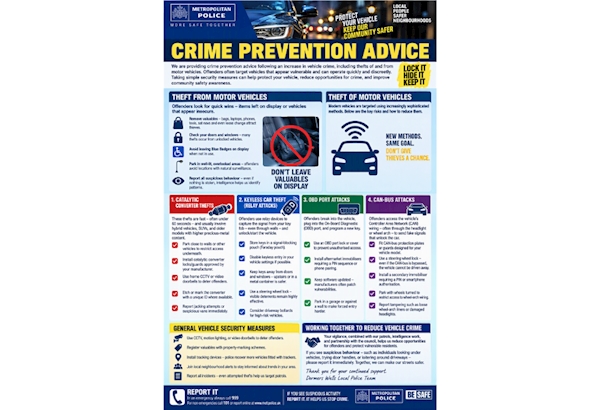
Car Crime Prevention Advice We are providing crime prevention advice following an increase in vehicle crime, including thefts of and from motor vehicles. Offenders often target vehicles that appear vulnerable and can operate quickly and discreetly. Taking simple security measures can help protect your vehicle, reduce opportunities for crime, and improve community safety awareness.
Theft From Motor Vehicles Offenders typically look for quick wins—items left on display or vehicles that appear insecure. Remove valuables — bags, laptops, phones, tools, sat‑navs, and even loose change attract thieves. Check your doors and windows — many thefts occur from unlocked vehicles. Avoid leaving Blue Badges on display when not in use. Park in well‑lit, overlooked areas — offenders avoid locations with natural surveillance. Report all suspicious behaviour — even if nothing is stolen, intelligence helps us identify patterns.
Theft Of Motor Vehicles
Modern vehicles are targeted using increasingly sophisticated methods. Below are the key risks and how to reduce them.
These thefts are fast—often under 60 seconds—and usually involve hybrid vehicles, SUVs, and older models with higher precious‑metal content. Park close to walls or other vehicles to restrict access underneath. Install catalytic converter locks/guards approved by your manufacturer. Use home CCTV or video doorbells to deter offenders. Etch or mark the converter with a unique ID where available. Report jacking attempts or suspicious vans immediately.
Offenders use relay devices to capture the signal from your key fob—even through walls—and unlock/start the vehicle. Store keys in a signal‑blocking pouch (Faraday pouch). Disable keyless entry in your vehicle settings if your manufacturer allows it. Keep keys away from doors and windows — upstairs or in a metal container is safer. Use a steering wheel lock — visible deterrents remain highly effective. Consider driveway bollards for high‑risk vehicles.
2. OBD Port Attacks Offenders break into the vehicle, plug into the On‑Board Diagnostic (OBD) port, and program a new key. Use an OBD port lock or cover to prevent unauthorised access. Install aftermarket immobilisers requiring a PIN sequence or phone pairing. Keep software updated — manufacturers often patch vulnerabilities. Park in a garage or against a wall to make forced entry harder.
3.CAN‑Bus Attacks A newer method where offenders access the vehicle’s Controller Area Network (CAN) wiring—often through the headlight or wheel arch—to send fake signals that unlock the car. Fit CAN‑bus protection plates or guards designed for your vehicle model. Use a steering wheel lock — even if the CAN‑bus is bypassed, the vehicle cannot be driven away. Install a secondary immobiliser requiring a PIN or smartphone authorisation. Park with wheels turned to restrict access to wheel‑arch wiring. Report tampering such as loose wheel‑arch liners or damaged headlights.3. General Vehicle Security Measures. Use CCTV, motion lighting, or video doorbells to deter offenders.
Register valuables with property‑marking schemes. Install tracking devices — police recover more vehicles fitted with trackers. Join local neighbourhood alerts to stay informed about trends in your area. Report all incidents — even attempted thefts help us target patrols.
Working Together to Reduce Vehicle Crime Your vigilance, combined with our patrols, intelligence work, and partnership with the council, helps us reduce opportunities for offenders and protect vulnerable residents. If you see suspicious behaviour—such as individuals looking under vehicles, trying door handles, or loitering around driveways—please report it immediately. Together, we can make our streets safer.
Thank you for your continued support. Yours sincerely, Southall West Local Police Team
| ||
Reply to this message | ||
|


|